Showing posts with label New Release. Show all posts

Thursday, October 20, 2011

Critiquerly Interview with Martha Alderson

(Or, Whisper Me a Plot and Win a Book)

In my last post, I alluded to the possibility of a Personal Change of Being. I may have just morphed, my fine, fine, writerly friends, from being a pantser to a plot planner. I’ve ripped open the seams of my current WiP, and started to sew a plot structure for not one, but two future WiPs.

And I’m going to share my big secret with you. It’s Martha Alderson, otherwise known as The Plot Whisperer.

I think I first came to know about Martha through a twitter link that took me to her vlog series. I watched the entire series in a day (all 27 of them), and within the next few weeks, I had my entire online critique group involved in a workshop centered around her videos. Some of us are fixing plot problems in current WiPs, and others are getting ready for nanowrimo.

This is why I’m falling over with a general stokedness today. Because Martha is here. On Not an Editor. With her thoughts about critiquing. And? She’s got some thought-provoking answers.


~~~


Martha Alderson has worked with hundreds of writers in sold-out plot workshops, retreats, and plot consultations for more than fifteen years. Her clients include bestselling authors, New York editors, and Hollywood movie directors. She lives in Santa Cruz, CA. Follow her blog, workshops, vlog, or follow her on twitter and faceboook.


~~~

NAE: After a writer gets back an in-depth critique, what would you recommend in terms of a review/revise process?

MA: I suggest that the writer sit with the input for a few days and let the information sink in and feel the effects of the feedback emotionally. Then, based on what the in-depth critique reveals, I suggest that the writer pull out a fresh piece of banner paper and re-plot the entire story on a new Plot Planner, incorporating the feedback that feels valid to her. Then, she can stand back and, minus the words, view her story as a whole and assess how the energy of the story rises and falls.


NAE:  What is the one piece of advice you can give to someone trying to develop his or her critique skills?

MA: Let me answer your question this way, I believe one of the best things a critiquer can do is always to separate the story from the writer. The story is the beginning and middle and end as a whole that involves characters and mostly one character as she is confronted with challenges and undergoes a meaningful transformation. The story is always whole and complete. The writer, on the other hand, in attempting to translate wisps of inspiration to the page is only as good as her current developmental skill level of writing.
When something is not working, it's not the story that is problematic, it is the writer as she continues to grow and study and reach for mastery over the story-telling process.


NAE: When you critique someone’s work, what is your general process?

MA: I never critique writers' work. I have found as a plot consultant to writers that I cannot see the forest (plot and structure) for the trees (words). Plot consultations focus exclusively on the master plot, which is made up of the action, character and thematic plot lines or, in other words, the form and structure. Writers are asked to have on hand a list of scenes from their projects and an idea of the message they are hoping their story will convey.

By pushing aside the words, I am better able to see the deeper structure of the story and assess what is working and what needs work.


NAE: Is there one specific thing that you gravitate toward while critiquing?

MA: I am most interested in how the dramatic action of the story affects the protagonist and how she transforms overtime and what that means overall. Minus the luster of words and phrases is the structure or form of the writer’s expression. Mysteries and depth are hiding in the stories right now. It is in the interlocking plotlines that they reveal themselves.


~~~

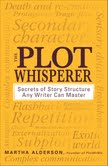
Thanks, Martha, for including us in your new book release blog tour, which gives me one last exciting announcement. I have a copy of The Plot Whisperer: Secrets of Story Structure Any Writer Can Master, and I’m ready to send it to one lucky winner. All you have to do is leave a comment below. If you’d like to tweet about this contest, I’ll smile sweetly and say thanks. Mr. Random Generator will pick our winner, to be announced next Tuesday. Of course, now that you’ve met Martha, you may not be able to wait to get her book. You. Want. This. Book.*


And here’s something I’d like to know in your comments today: Are you a pantser or a planner?


*Seriously. You do, you want this book. I’ve kept it by my side when I writer and critique ever since it’s found its way into my hands a few weeks ago.

Thursday, July 7, 2011

Critiquerly Interview with Author Medeia Sharif

(Or, Release-Day Give Away: Bestest. Ramadan. Ever.)

I met Medeia Sharif several months ago, during the Write-Hope auctions in March, which raised money for the younger victims of the tsunamis in Japan. Medeia's day 8, item 1 caught my eye, and I ended up winning her 50-page critique. Lucky me! Except, I didn't quite have 50 pages to send her because right after winning the auction, I decided to re-do my WiP in first person. (I know, I know. Bad me.)

Shortly thereafter, I decided to re-do some of the main plot elements. And change some characters around. And then? My WiP turned into a completely different story. Medeia faithfully checked in with me, always understanding that I needed just a few more weeks. And well, when all the faerie dust settled, my first 50 pages were finally ready for her just about two weeks ago. And my patient little Medeia, even though I'd come dangerously close to the release date of her debut YA (Bestest. Ramadan. Ever.), provided me with a timely, intelligent critique. Sigh.

To summarize, Medeia is fabulous because:

1. She donates her time to a worthy causes
2. She worked through a wonderful critique for me
3. Her debut YA novel has just been released
4. She seamlessly used critiquer in her interview below


Whew! Oh yes, let's not forget the best part. If you are able to show as much patience as Medeia (while she waited for my first 50), you'll find the give-away contest at the end of this post. *cue: standing ovation*


~~~


Medeia Sharif is a Kurdish-American author and high school English teacher.
She received her master's degree in psychology from Florida Atlantic University.
She lives in Miami Beach. Bestest. Ramadan. Ever. Is her debut novel.
She's got a terrific website/blog, she's on Twitter, and posts to Tumblr.

~~~

NAE: After a writer gets back an in-depth critique, what would you recommend in terms of a review/revise process?

MS: I would sit on the revision notes. I never dive into revisions right after a critique. I need time to digest the information. I let things stew for a week or two, and after my mind has wrapped itself around the revision notes and my own thoughts regarding the big picture of the manuscript, I'm ready to revise.

Not too long ago I received copious notes from several readers. I thought, "What am I supposed to do with this?" and "Revising will take too darn long." I felt overwhelmed. Once I let some time go by, I was able to redo my outline, plug in necessary changes, and comfortably swing into motion.


NAE: What is the one piece of advice you can give to someone trying to develop his or her critique skills?

MS:
The best way to develop critique skills is to watch others critique, whether they do it verbally or through note-taking. Both online and in person I observed how other people gave feedback. After my observations my critiques became more detailed and, based on people's gratitude, more helpful. And as time goes by, I'll get better at critiquing since I'm still learning about the process.


NAE: When you critique someone's work, what is your general process?

MS: If it's a chapter, I read it several times. If it's a longer piece, I'll read it once or twice at a slower pace. I line edit as I go along—I can't help it when I see an error—but I know I don't catch all the mistakes since I'm more focused on the story than the grammar.


NAE: Is there one specific thing that you gravitate toward while critiquing?

MS: I'll take note of everything, but I gravitate towards plot and pacing. This stems from being a plotter; before I start a WiP I spend quite a bit of time creating spreadsheets to see where action turns.


Question added by MS: What qualities should one look for in CPs?

MS:
Right now I receive critiques from people who are in various stages of writing. They are newbies, unpublished but have been writing for years, agented, soon-to-be-published, and published. All of them provide valuable input. They're dedicated writers who are sincerely interested in the writing and publishing process. Basically, you need to find people who have a passion for writing and who keep up with the market. In addition to craft, CPs should be able to discuss trends, age levels, genre, and other concerns that affect a manuscript. They'll all be at different levels of the critiquing spectrum, but you need to have a few seasoned critiquers in the bunch to lead and inspire everyone.


~~~
Thanks, Medeia!

Give Away Contest & Rules

PRIZE: A copy of Medeia's YA debut, BESTEST. RAMADAN. EVER. along with a signed bookmark (no, not signed by me, silly. Medeia signed it!). This prize is a matching set. So gorgeous together. Oh yes, you want this. Your friends will be so, so jealous.


TO ENTER: Just leave a comment!


That's it. The contest ends Sunday (7/10) at midnight, CST. Winner will be selected via random number generator. Good luck!